
Guide
Best Cars for New Drivers to Insure
What makes a car cheap or expensive to insure for a new driver—size, safety ratings, repair cost, theft rates, horsepower—and how to check before buying.

By Caleb Hartman · Staff Writer
Published · Updated
Answer in brief
The right car can cut a new driver's premium by 30–50% compared with the wrong one. Cheap-to-insure cars for new drivers share traits: mid-size sedans and small SUVs rather than small cars or sports models, modest horsepower, strong crash-test ratings, low repair costs and low theft rates. Highway-safety researchers publish lists of recommended used vehicles for teens that are a good starting point. Always get an insurance quote on a specific car before buying it.
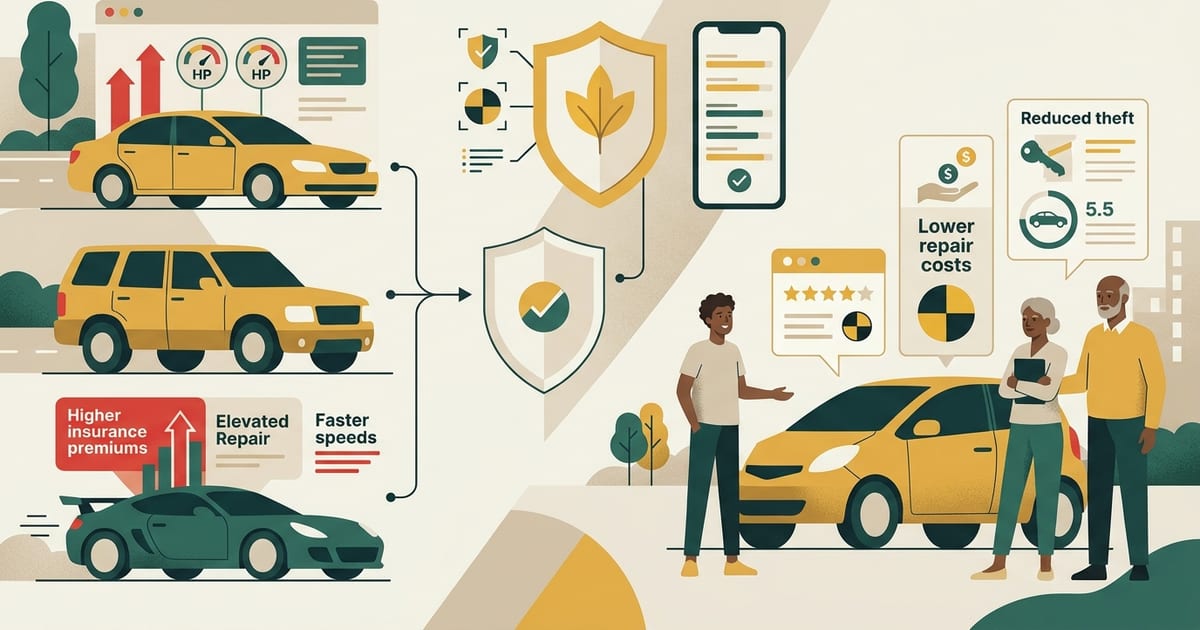
What insurers look at in a vehicle
- Loss history for the model. Industry databases track claim frequency and cost by make, model and year. A model with high collision losses costs more regardless of who drives it.
- Repair cost. Vehicles with expensive body panels, sensors in bumpers and aluminium structures cost more to fix.
- Horsepower and performance image. Sports cars and high-output trims carry higher rates, and more so for young drivers.
- Size and weight. Mid-size and larger vehicles protect occupants better, lowering injury claims—but very large SUVs and trucks cause more damage to others.
- Theft rate. Some models are stolen far more often, raising comprehensive premiums.
- Safety equipment. Electronic stability control, automatic emergency braking and good crash ratings reduce injury costs.
The new-driver sweet spot
Researchers who study teen crashes recommend a specific profile: a mid-size or larger vehicle, not a sports car, with electronic stability control and strong crash-test ratings, ideally a few years old to keep the purchase price and collision premium down. In practice that means mainstream mid-size sedans, small and mid-size SUVs, and some minivans. Many of these are also among the cheapest vehicles to insure in general.
Cars to avoid for a first policy
- Sports cars and performance trims of ordinary models.
- Very small cars—poor occupant protection raises injury premiums.
- Full-size pickups and large SUVs—high liability losses and high repair costs.
- Luxury brands—expensive parts and higher theft.
- Modified vehicles—many insurers surcharge or decline them.
Quote finder
Find auto insurance quotes that fit your situation
Check before you buy
Quote the exact year, make and model (VIN if possible) with the new driver listed before signing anything. The difference between two cars that look similar on a lot can be a thousand dollars a year. Our article on what makes a car cheap to insure goes deeper.
Entries in this guide
Specific questions answered in more depth.
Questions & answers
Are older cars cheaper to insure for new drivers?
Usually—lower value means lower collision and comprehensive cost—but very old cars lack safety features that lower injury claims. A 5–10 year old mid-size car is often the best balance.
Are SUVs cheaper to insure than sedans?
Small and mid-size SUVs are often similar to sedans; large SUVs and trucks are usually more expensive because they cause more damage in crashes.
Does car colour affect insurance?
No. Insurers do not rate on colour.
Terms used in this guide
- Vehicle rating symbol
- A number an insurer assigns to each make/model/year from its claims history and cost, driving the collision and comprehensive premium.
- Collision coverage
- Pays to repair or replace your own car after a crash, minus the deductible.
- Comprehensive coverage
- Pays for non-crash damage: theft, weather, vandalism, fire, animal strikes, glass.
Sources and references
Legal figures on this page (minimum limits, filing periods, statutory benefits) are checked against the primary law or the state insurance regulator listed below. Links and figures last verified Nov 2026.
- Teenagers — Insurance Institute for Highway SafetyIndependent researchTeen crash risk, graduated driver licensing research and vehicle recommendations for young drivers.
- Graduated licensing laws by state — Insurance Institute for Highway SafetyIndependent researchState-by-state learner, intermediate and full-licence ages, night-driving and passenger restrictions.
- Vehicle ratings — Insurance Institute for Highway SafetyStatistical dataCrashworthiness and crash-avoidance ratings by make and model.
- Insurance losses by make and model — Highway Loss Data InstituteStatistical dataRelative claim frequency and severity by vehicle under collision, property damage, comprehensive, PIP, MedPay and bodily injury coverages.
- Fatality facts: Teenagers — Insurance Institute for Highway Safety (2024)Statistical dataFatal crash rate per mile driven for 16–19-year-olds is just over 3 times the rate for drivers 20 and older (2022 travel data); all-severity crash rate is over 4 times; risk is highest at 16–17.
- Drivers in fatal motor vehicle crashes by age, 2023 — Insurance Information Institute (2025)Statistical dataFatal-crash involvement per 100,000 licensed drivers: 42.40 (16–20), 35.34 (21–24), 28.97 (25–34), 24.18 (35–44), 21.70 (45–54), 19.45 (55–64), 15.44 (65–74), 16.63 (75+).
- How much auto coverage do I need? — Insurance Information InstituteConsumer guidanceWhy state minimums are a floor; choosing liability limits that protect assets; when collision and comprehensive are worth keeping.
- Auto insurance for teen drivers — Insurance Information InstituteConsumer guidanceAdding a teen to a parent's policy versus a separate policy; good-student and driver-training discounts; vehicle choice.
Practical guidance on this page is original editorial work. Cited sources support factual statements and do not endorse this site. Dollar ranges described as typical or illustrative are editorial estimates, not figures from these sources.
Guide
What Coverage a New Driver Should Choose
Liability limits, collision and comprehensive, uninsured motorist and deductibles for a first policy—what matters, what is optional, and why minimum limits are a poor fit for new drivers.
Guide
How Much Car Insurance Costs for New Drivers
What new drivers pay for car insurance by age, why inexperience is priced so heavily, and how the premium falls over the first three years.
Guide
Car Insurance Discounts for New Drivers
Good student, driver training, telematics, distant student and other discounts that specifically reduce new-driver premiums—with realistic ranges.