
Guide
A New Driver's First Accident or Ticket
What happens to a new driver's premium after a first at-fault accident or speeding ticket, how long it lasts, and what to do about it.

By Caleb Hartman · Staff Writer
Published · Updated
Answer in brief
A first at-fault accident typically raises a new driver's premium by 30–60% and a minor speeding ticket by 10–25%, each for about three years. The dollar impact is large because the base premium is already high. Not-at-fault accidents and comprehensive claims usually do not carry a surcharge. Accident forgiveness, where available, can protect the first incident, but it must be on the policy before the crash. The response is the same as for any driver: keep the record clean from here, consider a defensive-driving course, and compare insurers at the next renewal.
Accidents
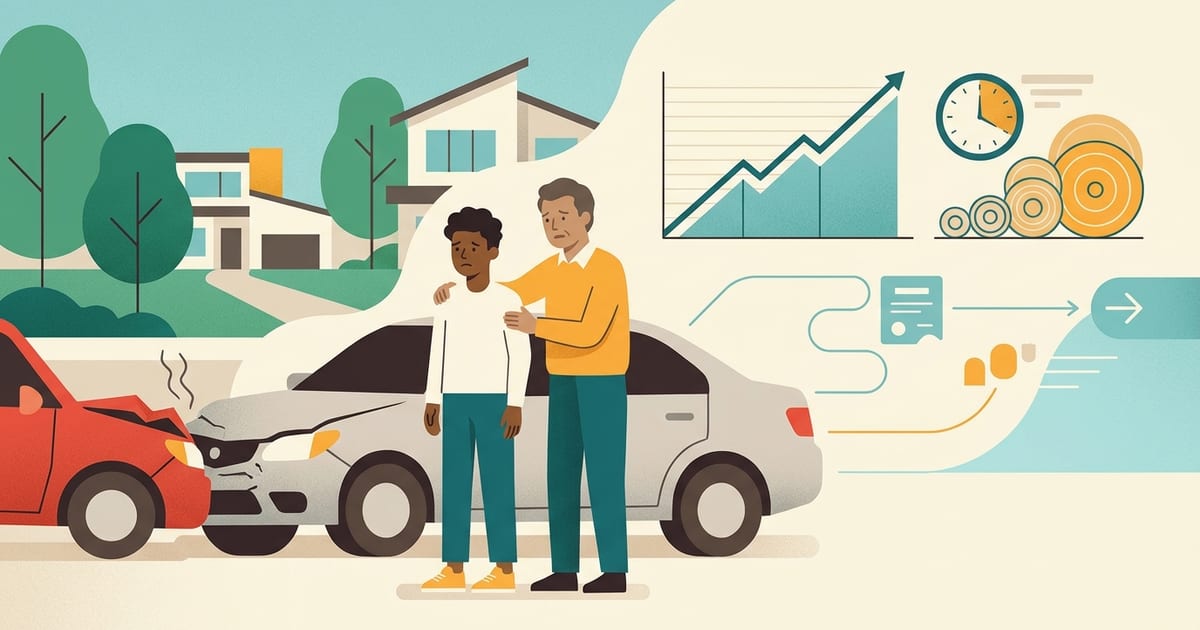
Insurers surcharge at-fault accidents, usually when the claim paid exceeds a small threshold (often $750–$1,000). The surcharge is a percentage, so it compounds a high new-driver premium: a 40% surcharge on a $4,000 premium is $1,600 a year. Not-at-fault accidents, where the other driver's insurer pays, generally carry no surcharge, though some insurers consider claim frequency.
Tickets
A minor speeding ticket (under 15 over) typically adds 10–25%. Serious violations—reckless driving, racing, 30+ over, or any violation on a graduated licence—can add far more or trigger nonrenewal. Many states also impose licence consequences for teen drivers at lower point totals than for adults.
Accident forgiveness
Some insurers offer accident forgiveness, either as a purchased add-on or earned after several clean years. It prevents the first at-fault accident from raising the rate. It must already be on the policy when the crash occurs, and it typically applies once per policy. For a family adding a new driver, asking about forgiveness before the first year is sensible.
Quote finder
Find auto insurance quotes that fit your situation
What to do after the first incident
- Report the accident promptly and honestly; late or inaccurate reporting is a bigger problem than the claim.
- Ask whether a defensive-driving course can remove points or earn a discount in your state.
- Keep the record clean—the surcharge expires in about three years if nothing else happens.
- Compare insurers at the next renewal; surcharge sizes differ, and some companies are more forgiving of a single incident.
Entries in this guide
Specific questions answered in more depth.
Questions & answers
How much will my teen's insurance go up after an accident?
Typically 30–60% for an at-fault accident, for about three years.
Should I pay for minor damage myself?
For damage close to the deductible with no injuries, paying out of pocket can avoid a surcharge. Any crash with injuries or another vehicle should be reported.
Does a ticket on a learner's permit affect insurance?
It can, once the driver is rated. Some states also extend the permit period for violations.
Terms used in this guide
- Surcharge
- A percentage added to the premium for an at-fault accident or violation, usually for three years.
- Accident forgiveness
- A policy feature that prevents a first at-fault accident from raising the premium. Must be on the policy before the crash.
- At-fault accident
- A crash the insurer determines you caused (wholly or mostly). At-fault accidents are surcharged; not-at-fault ones usually are not.
- Clean record
- No at-fault accidents or moving violations within the insurer's lookback period, usually three to five years.
Sources and references
Legal figures on this page (minimum limits, filing periods, statutory benefits) are checked against the primary law or the state insurance regulator listed below. Links and figures last verified Nov 2026.
- Speed — Insurance Institute for Highway SafetyIndependent researchHow speed raises crash likelihood and severity; speed-limit and enforcement research.
- Teenagers — Insurance Institute for Highway SafetyIndependent researchTeen crash risk, graduated driver licensing research and vehicle recommendations for young drivers.
- Graduated licensing laws by state — Insurance Institute for Highway SafetyIndependent researchState-by-state learner, intermediate and full-licence ages, night-driving and passenger restrictions.
- Fatality facts: Teenagers — Insurance Institute for Highway Safety (2024)Statistical dataFatal crash rate per mile driven for 16–19-year-olds is just over 3 times the rate for drivers 20 and older (2022 travel data); all-severity crash rate is over 4 times; risk is highest at 16–17.
- Drivers in fatal motor vehicle crashes by age, 2023 — Insurance Information Institute (2025)Statistical dataFatal-crash involvement per 100,000 licensed drivers: 42.40 (16–20), 35.34 (21–24), 28.97 (25–34), 24.18 (35–44), 21.70 (45–54), 19.45 (55–64), 15.44 (65–74), 16.63 (75+).
- What determines the price of an auto insurance policy? — Insurance Information InstituteConsumer guidanceRating factors: driving record, mileage, location, age, gender, vehicle, credit-based insurance score, coverage choices. Notes ZIP-code rating is prohibited in California and Michigan and gender rating is prohibited in seven states.
- Nine ways to lower your auto insurance costs — Insurance Information InstituteConsumer guidanceShop at least three quotes; raising a deductible from $200 to $500 can cut collision/comprehensive cost 15–30%, $1,000 can save 40%+; drop physical damage on cars worth under 10× the premium; bundling, low-mileage and good-student discounts.
- Auto insurance for teen drivers — Insurance Information InstituteConsumer guidanceAdding a teen to a parent's policy versus a separate policy; good-student and driver-training discounts; vehicle choice.
Practical guidance on this page is original editorial work. Cited sources support factual statements and do not endorse this site. Dollar ranges described as typical or illustrative are editorial estimates, not figures from these sources.
Guide
How Fast Car Insurance Rates Drop for New Drivers
The year-by-year path from a first-policy premium to a normal one: inexperience factors, age bands, and the renewals where comparing pays most.
Guide
How to Compare Car Insurance for a New Driver
A method for comparing new-driver quotes: fixed coverage set, same inputs, discounts applied consistently, and the questions to ask each insurer.
Guide
What Coverage a New Driver Should Choose
Liability limits, collision and comprehensive, uninsured motorist and deductibles for a first policy—what matters, what is optional, and why minimum limits are a poor fit for new drivers.