
Guide
What Coverage a New Driver Should Choose
Liability limits, collision and comprehensive, uninsured motorist and deductibles for a first policy—what matters, what is optional, and why minimum limits are a poor fit for new drivers.

By Priya Raman · Editor
Published · Updated
Answer in brief
New drivers have above-average crash risk, which makes liability limits the most important choice on a first policy—not the least. State minimums (often 25/50/25 or lower) can be exhausted by a single injury claim; 50/100/50 or 100/300/100 is a far better fit and usually costs only a little more. Collision and comprehensive are required on a financed car and worth keeping on any car worth more than a few thousand dollars. Uninsured motorist coverage protects the new driver when the other party has nothing. Raising the deductible is the right way to lower the premium; cutting liability is not.
Liability: where not to economise
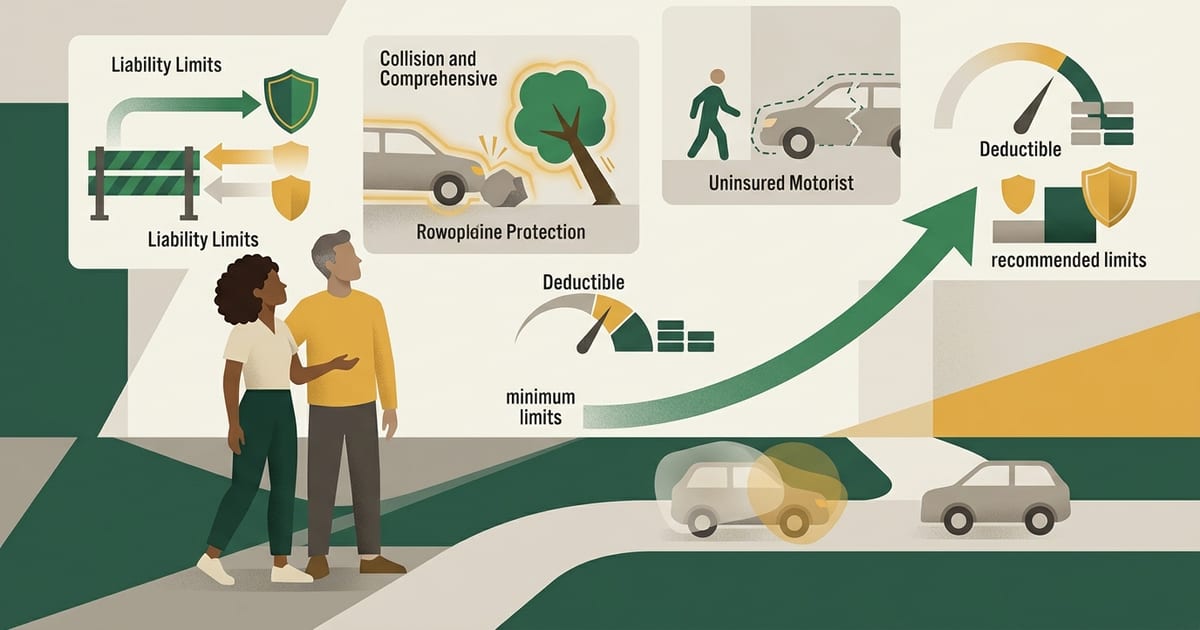
Liability coverage pays for the injuries and damage a driver causes to others. A new driver is statistically more likely to cause a crash, so the probability of a liability claim is higher than average—exactly the wrong time to carry the minimum. Moving from 25/50/25 to 100/300/100 commonly adds 10–20% to the liability portion of the premium while quadrupling protection. For a teen on a family policy, the whole household's assets are behind the policy, which is another reason parents usually raise limits when adding a new driver.
Collision and comprehensive
Collision pays to fix the new driver's own car after a crash; comprehensive pays for theft, weather, vandalism and animal strikes. Both are required by lenders. On an owned car, the question is whether the car's value justifies the premium. A $4,000 first car driven by a 17-year-old might cost $1,200 a year to cover for collision—a poor trade. A $15,000 car is a different calculation. The best cars guide covers the vehicle side.
Uninsured motorist
UM pays for the new driver's own injuries when the at-fault party is uninsured or underinsured. It is inexpensive relative to what it protects and is required or must be offered in most states. Match it to the liability limit.
Quote finder
Find auto insurance quotes that fit your situation
Deductibles
A $1,000 deductible instead of $500 cuts collision and comprehensive premium by roughly 15–25%, and because new-driver premiums are high the dollar saving is large. The trade-off is simple: the household must be able to pay the deductible after a crash. For many families, a higher deductible funded by a small emergency reserve is the best way to make full coverage affordable.
Entries in this guide
Specific questions answered in more depth.
Entry
Why New Drivers Need Uninsured Motorist Coverage
Learn why uninsured motorist protection is critical for new drivers, how state uninsured rates affect risk, and how to select proper policy limits.
Entry
How to Choose a Car Insurance Deductible as a New Driver
Learn how choosing between a $500 and $1,000 deductible affects car insurance premiums for new drivers, and how to pick the right out-of-pocket balance.
Questions & answers
Should a new driver get full coverage?
If the car is financed, yes—it is required. If owned, keep collision and comprehensive while the car is worth meaningfully more than the annual cost of those coverages plus the deductible.
Is minimum liability enough for a teen?
Rarely. A single injury claim can exceed 25/50 limits, and the household is liable for the rest.
What deductible should a new driver have?
$1,000 if the household can pay it; the saving on a high new-driver premium is substantial.
Terms used in this guide
- Liability limits
- The maximum your policy pays for injuries and damage you cause, written as three numbers such as 100/300/100 (in thousands).
- Collision coverage
- Pays to repair or replace your own car after a crash, minus the deductible.
- Comprehensive coverage
- Pays for non-crash damage: theft, weather, vandalism, fire, animal strikes, glass.
- Deductible
- What you pay before collision or comprehensive pays. Higher deductibles lower the premium.
- Uninsured/underinsured motorist coverage
- Pays for your injuries when the at-fault driver has no or too little insurance.
Sources and references
Legal figures on this page (minimum limits, filing periods, statutory benefits) are checked against the primary law or the state insurance regulator listed below. Links and figures last verified Nov 2026.
- 14 percent of U.S. drivers were uninsured in 2022 — Insurance Research Council (2023)Independent researchAbout one in seven drivers was uninsured in 2022; highest D.C. 25.2%, New Mexico 24.9%, Mississippi 22.2%; lowest Wyoming 5.9%, Maine 6.2%, Idaho 6.2%. Method: ratio of UM to BI claim frequencies.
- Facts + Statistics: Uninsured motorists — Insurance Information Institute (2024)Statistical dataInsurance Research Council estimates of uninsured drivers by state (2022: e.g. Michigan 19.6%, California 17.0%, Florida 15.9%, Texas 13.8%).
- Automobile financial responsibility limits by state — Insurance Information Institute (2023)Statistical dataCompulsory coverages and minimum liability limits by state (table dated December 2023 — several states have raised limits since; see statute entries).
- Estimated percentage of uninsured motorists by state, 2017–2023 — Insurance Information Institute (2025)Statistical dataIRC time series by state; 2023: Mississippi 28.2%, New Mexico 24.1%, D.C. 23.1%, Michigan 22.3%, Florida 20.6%, California 20.4%, Texas 14.5%; lowest Maine 5.7%.
- What is covered by a basic auto insurance policy? — Insurance Information InstituteConsumer guidanceDefines bodily injury and property damage liability, MedPay, PIP, uninsured/underinsured motorist, collision, comprehensive and glass coverage.
- How much auto coverage do I need? — Insurance Information InstituteConsumer guidanceWhy state minimums are a floor; choosing liability limits that protect assets; when collision and comprehensive are worth keeping.
- Consumer insurance information — National Association of Insurance CommissionersConsumer guidancePlain-language guides from the body of state insurance regulators; links to every state's insurance department and complaint process.
- Is it legal to drive without insurance? — Insurance Information InstituteConsumer guidanceEvery state requires drivers to demonstrate financial responsibility; in most states insurance is the mandatory way to do so.
Practical guidance on this page is original editorial work. Cited sources support factual statements and do not endorse this site. Dollar ranges described as typical or illustrative are editorial estimates, not figures from these sources.
Guide
Own Policy vs Parents' Policy for a New Driver
When a new driver should be added to a parent's policy, when a separate policy makes sense, and how vehicle ownership and address affect the answer.
Guide
Best Cars for New Drivers to Insure
What makes a car cheap or expensive to insure for a new driver—size, safety ratings, repair cost, theft rates, horsepower—and how to check before buying.
Guide
How to Compare Car Insurance for a New Driver
A method for comparing new-driver quotes: fixed coverage set, same inputs, discounts applied consistently, and the questions to ask each insurer.