
Entry in What Coverage a New Driver Should Choose
Why New Drivers Need Uninsured Motorist Coverage
Learn why uninsured motorist protection is critical for new drivers, how state uninsured rates affect risk, and how to select proper policy limits.

By Priya Raman · Editor
Published
Answer in brief
Uninsured motorist coverage protects new drivers from paying out of pocket when hit by a driver who carries no insurance or flees the scene. With roughly one in seven drivers nationwide lacking coverage—and state rates climbing as high as 28%—this protection bridges the gap between basic state minimums and real medical expenses. Adding uninsured and underinsured motorist coverage provides essential financial stability while building an early driving record.
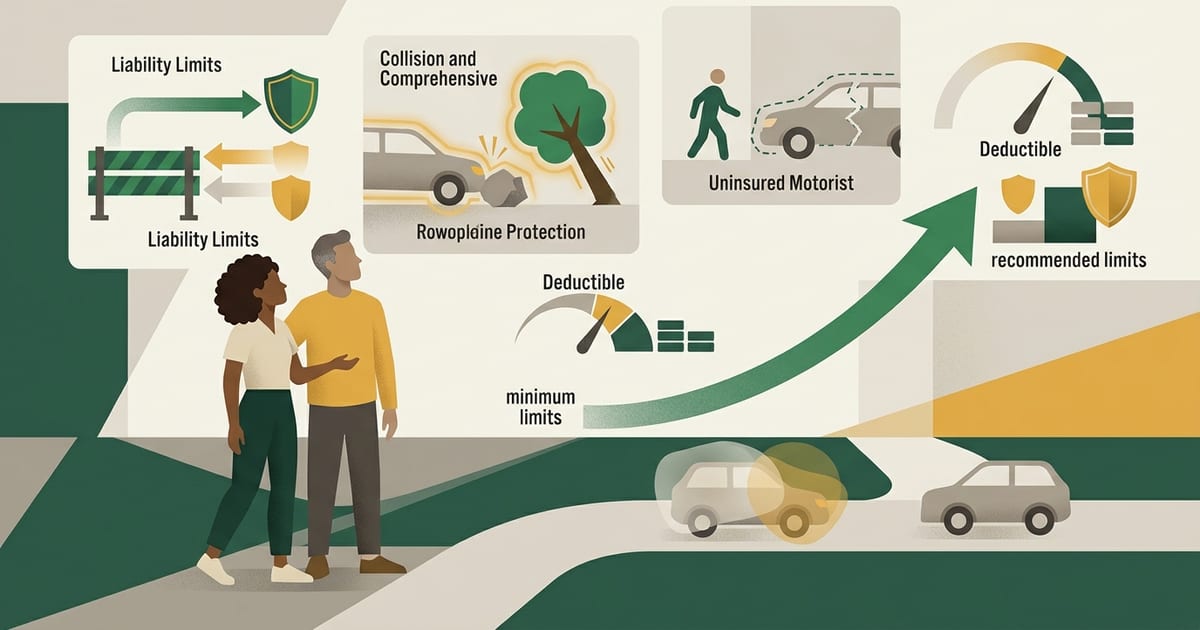
What Uninsured Motorist Coverage Does for a Beginner
When a beginner gets behind the wheel, their primary policy focus is usually satisfying statutory requirements. Every state requires drivers to demonstrate financial responsibility to operate a vehicle legally, and purchasing an insurance policy is the primary way motorists fulfill that requirement. However, state minimum requirements only protect other motorists when you cause damage. They do not pay for your medical bills or vehicle repairs if someone else crashes into you.
This is where uninsured motorist coverage becomes vital. Known in the industry as UM, this coverage steps into the shoes of an at-fault driver who broke the law by carrying no active policy. A related endorsement, underinsured motorist (UIM) coverage, triggers when an at-fault motorist carries insurance, but their policy limits are too low to pay the full cost of your losses. When you are exploring what coverage a new driver should choose, evaluating UM and UIM is just as critical as selecting your baseline liability limits.
| State / Jurisdiction | 2022 Estimated Uninsured Rate | 2023 Estimated Uninsured Rate | Risk Environment |
|---|---|---|---|
| Mississippi | 22.2% | 28.2% | Highest in Country |
| New Mexico | 24.9% | 24.1% | Very High |
| District of Columbia | 25.2% | 23.1% | Very High |
| Michigan | 19.6% | 22.3% | High |
| Florida | 15.9% | 20.6% | High |
| California | 17.0% | 20.4% | High |
| Texas | 13.8% | 14.5% | National Average |
| Maine | 6.2% | 5.7% | Lowest in Country |
Data published by the Insurance Research Council shows that nationwide, approximately 14 percent of U.S. drivers were uninsured in 2022—roughly one out of every seven cars on the road. In states like Mississippi, New Mexico, Michigan, and Florida, the probability of an incident involving an uninsured driver is significantly higher. For an inexperienced driver who is still mastering defensive positioning, encountering an uninsured motorist is a realistic hazard that requires financial safeguards.
Bodily Injury vs Property Damage UM Coverage
Uninsured motorist coverage is split into two distinct mechanisms: bodily injury (UMBI) and property damage (UMPD). UMBI pays for emergency medical treatment, hospital stays, ongoing rehabilitation, and funeral costs for you and your passengers if struck by an uninsured or hit-and-run driver. Because health insurance plans often leave high out-of-pocket deductibles and copays, UMBI acts as a direct safety net for medical debt.
UMPD, on the other hand, pays to repair or replace your vehicle if an uninsured driver damages it. In many states where UMPD is available, it includes a statutory deductible. However, if you already carry physical damage protection through collision coverage, UMPD may be optional or duplicative, because collision pays for damage to your car regardless of who caused the crash. Examining your existing policy structure ensures you do not buy redundant protection while keeping your overall premium manageable.
How to Add UM and UIM Protection Properly
- 1
Match UM Limits to Your Liability Limits
Insurers generally allow you to purchase UM coverage up to the bodily injury liability limits on your base policy. Setting your UM limits to match your liability coverage ensures you protect yourself to the exact same standard you protect strangers on the road.
- 2
Verify State Specific Rules
Check your state insurance department rules to determine whether UM covers hit-and-run incidents without physical contact, or if vehicle contact is strictly required to open a claim.
- 3
Review Collision Coverage Overlap
If your vehicle is older and does not carry collision coverage, adding UMPD is critical so a crash with an uninsured driver does not leave you with a total financial loss.
- 4
Obtain Written Documentation
If you adjust limits, ensure the declarations page clearly displays both UMBI and UIM endorsements before completing the binding process.
Evaluating the Added Premium for First-Time Drivers
New drivers already face elevated base rates because actuarial data reflects higher claim frequencies during the early years of licensing. While understanding how much car insurance costs for new drivers is a priority, dropping UM coverage to save money creates severe exposure. The countrywide average expenditure for auto insurance was $1,281 in 2023, with a combined average premium of $1,438 according to NAIC data. Within that overall total, UM coverage represents a modest portion of the annual bill while providing hundreds of thousands of dollars in potential injury protection.
Regulators and consumer guides emphasize that statutory minimums represent a legal floor, not a recommended financial shelter. If an uninsured driver causes severe injury to an inexperienced motorist, medical expenses can easily exceed basic coverage minimums within days. Understanding how to compare car insurance allows families to shop across multiple carriers to secure robust UM limits without overpaying for standard operational coverage.
Questions & answers
Does uninsured motorist coverage pay if the at-fault driver flees the scene?
In most states, uninsured motorist bodily injury coverage applies to hit-and-run accidents where the at-fault driver cannot be identified. However, some jurisdictions require physical vehicle contact or an official crash report filed within a specific timeframe.
Can I decline uninsured motorist coverage to lower my bill?
In states where UM is not compulsory by law, insurers typically require policyholders to sign a formal rejection form to exclude it. While declining it lowers your total premium, it leaves you personally responsible for injury bills caused by uninsured motorists.
What is the difference between uninsured and underinsured motorist coverage?
Uninsured motorist coverage applies when the at-fault driver has no active auto insurance at all. Underinsured motorist coverage pays when the at-fault driver has insurance, but their policy limits are insufficient to cover the full medical or repair costs resulting from the accident.
Do I need uninsured motorist property damage if I already have collision coverage?
Collision coverage pays for damage to your vehicle from an accident regardless of fault. In many states where collision is active, UMPD is optional or unavailable, though some drivers use UMPD because it may carry a lower deductible than their collision policy.
Terms: Uninsured/underinsured motorist coverage, Liability limits, Collision coverage, Deductible, Premium
Sources and references
Legal figures on this page (minimum limits, filing periods, statutory benefits) are checked against the primary law or the state insurance regulator listed below. Links and figures last verified Nov 2026.
- 14 percent of U.S. drivers were uninsured in 2022 — Insurance Research Council (2023)Independent researchAbout one in seven drivers was uninsured in 2022; highest D.C. 25.2%, New Mexico 24.9%, Mississippi 22.2%; lowest Wyoming 5.9%, Maine 6.2%, Idaho 6.2%. Method: ratio of UM to BI claim frequencies.
- Estimated percentage of uninsured motorists by state, 2017–2023 — Insurance Information Institute (2025)Statistical dataIRC time series by state; 2023: Mississippi 28.2%, New Mexico 24.1%, D.C. 23.1%, Michigan 22.3%, Florida 20.6%, California 20.4%, Texas 14.5%; lowest Maine 5.7%.
- 2019–2023 Auto Insurance Database: average premium supplement — National Association of Insurance Commissioners (2025)Statistical dataCountrywide average expenditure $1,281 in 2023 (+13.98%); combined average premium $1,438; state tables for liability, collision and comprehensive.
- Facts + Statistics: Uninsured motorists — Insurance Information Institute (2024)Statistical dataInsurance Research Council estimates of uninsured drivers by state (2022: e.g. Michigan 19.6%, California 17.0%, Florida 15.9%, Texas 13.8%).
- What is covered by a basic auto insurance policy? — Insurance Information InstituteConsumer guidanceDefines bodily injury and property damage liability, MedPay, PIP, uninsured/underinsured motorist, collision, comprehensive and glass coverage.
- How much auto coverage do I need? — Insurance Information InstituteConsumer guidanceWhy state minimums are a floor; choosing liability limits that protect assets; when collision and comprehensive are worth keeping.
- Is it legal to drive without insurance? — Insurance Information InstituteConsumer guidanceEvery state requires drivers to demonstrate financial responsibility; in most states insurance is the mandatory way to do so.
- Consumer insurance information — National Association of Insurance CommissionersConsumer guidancePlain-language guides from the body of state insurance regulators; links to every state's insurance department and complaint process.
Practical guidance on this page is original editorial work. Cited sources support factual statements and do not endorse this site. Dollar ranges described as typical or illustrative are editorial estimates, not figures from these sources.
Entry
How to Choose a Car Insurance Deductible as a New Driver
Learn how choosing between a $500 and $1,000 deductible affects car insurance premiums for new drivers, and how to pick the right out-of-pocket balance.
Parent guide
What Coverage a New Driver Should Choose
Liability limits, collision and comprehensive, uninsured motorist and deductibles for a first policy—what matters, what is optional, and why minimum limits are a poor fit for new drivers.